Introduction
Deep Learning has become one of the most advanced and powerful technologies in the field of Artificial Intelligence. It is changing the way computers understand information, recognize patterns, and perform tasks that were once considered possible only for humans.
From voice assistants and facial recognition systems to medical diagnosis and autonomous vehicles, deep learning is becoming an essential part of modern technology. Many of the intelligent applications people use every day are powered by deep learning models working behind the scenes.
The rapid growth of digital data, powerful computer processors, and advanced algorithms has made deep learning one of the fastest-growing areas of computer science. Organizations around the world are investing in deep learning to create smarter systems, improve decision-making, and solve complex problems.
Unlike traditional computer programs that require specific instructions, deep learning systems can learn from large amounts of data and improve their performance over time. This ability allows machines to understand images, text, speech, and other forms of information with remarkable accuracy.
This complete guide explains the meaning of deep learning, how it works, its applications, benefits, challenges, and its role in shaping the future of technology.
What Is Deep Learning?
Deep Learning is a specialized branch of Artificial Intelligence and Machine Learning that enables computers to learn from large amounts of data using artificial neural networks.
The word “deep” refers to the multiple layers of artificial neurons used in these networks. These layers allow machines to process information step by step and learn complex patterns.
A deep learning system works in a way that is inspired by the human brain. Just as humans use networks of neurons to understand information, deep learning models use artificial neural networks to analyze data and produce intelligent results.
For example, when a deep learning system analyzes an image, it does not simply look at the entire picture at once. Instead, different layers identify different features:
- Early layers detect simple patterns such as lines and colors.
- Middle layers recognize shapes and structures.
- Advanced layers understand complete objects and meanings.
This layered learning process allows deep learning systems to perform highly complex tasks.
Why Is Deep Learning Important?
Deep Learning is important because modern technology produces massive amounts of data every second. Traditional methods often struggle to process and understand such complex information.
Deep learning provides powerful solutions by allowing computers to automatically discover patterns and make accurate predictions.
Some major reasons why deep learning is important include:
1. Advanced Data Processing
Deep learning can analyze huge amounts of unstructured data, including images, videos, audio files, and text documents.
2. Human-Like Understanding

Deep learning models can recognize speech, understand languages, identify objects, and perform tasks similar to human intelligence.
3. Automation and Efficiency
Businesses use deep learning to automate complex processes, reduce errors, and improve productivity.
4. Better Decision Making
Deep learning helps organizations make informed decisions by analyzing patterns and predicting future outcomes.
History of Deep Learning
The roots of deep learning go back to early research in Artificial Intelligence and neural networks.
In the 1940s and 1950s, scientists began studying how the human brain processes information and created early concepts of artificial neurons.
During the 1980s, researchers developed improved neural network techniques, but limited computing power and insufficient data slowed progress.
The major breakthrough came in the 2000s when several factors helped deep learning grow rapidly:
- Powerful graphics processing units (GPUs)
- Large digital datasets
- Improved neural network algorithms
- Increased internet usage
In recent years, deep learning has achieved remarkable success in areas such as image recognition, natural language processing, robotics, and healthcare technology.
Today, deep learning is considered one of the most important technologies driving modern Artificial Intelligence.
Frequently Asked Questions (FAQs) About Deep Learning
1. What is Deep Learning in simple words?
Deep Learning is a type of Artificial Intelligence technology that allows computers to learn from large amounts of data and improve their ability to perform tasks. It uses artificial neural networks that are inspired by the structure of the human brain.
2. What is the difference between Deep Learning and Machine Learning?
Machine Learning is a broad field of Artificial Intelligence that allows computers to learn from data. Deep Learning is a specialized part of Machine Learning that uses multi-layer neural networks to analyze complex information and make advanced predictions.
3. How does Deep Learning work?
Deep Learning works through artificial neural networks containing multiple layers. These layers process data, identify patterns, learn important features, and produce results such as predictions, classifications, or decisions.
4. What are neural networks in Deep Learning?
Neural networks are computer systems designed to work similarly to the human brain. They contain connected artificial neurons that process information and help machines recognize patterns in data.
5. Where is Deep Learning used?
Deep Learning is used in many industries, including healthcare, finance, education, transportation, cybersecurity, and entertainment. Common examples include facial recognition, voice assistants, medical imaging, recommendation systems, and self-driving vehicles.
6. Why is Deep Learning important?
Deep Learning is important because it helps computers understand complex information such as images, speech, and language. It allows organizations to automate tasks, improve accuracy, and create smarter technologies.
7. What programming languages are used for Deep Learning?
Python is the most commonly used programming language for Deep Learning because it provides powerful libraries and frameworks. Other languages such as R, Java, and C++ are also used in specific applications.
8. What are the main types of Deep Learning networks?
Some common types of Deep Learning networks include:
- Artificial Neural Networks (ANN)
- Convolutional Neural Networks (CNN)
- Recurrent Neural Networks (RNN)
- Generative Adversarial Networks (GAN)
Each network type is designed for different types of tasks.
9. Can Deep Learning work without data?
No, Deep Learning requires large amounts of data to learn patterns and improve performance. The quality and quantity of data directly affect the accuracy of deep learning models.
10. What is the future of Deep Learning?
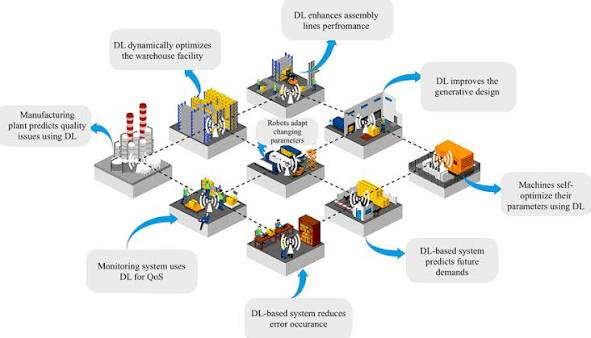
The future of Deep Learning is expected to bring more advanced Artificial Intelligence systems, smarter automation, improved healthcare solutions, better robotics, and more personalized digital experiences.
Conclusion: The Future of Deep Learning
Deep Learning has become a revolutionary technology that is transforming the way machines understand and process information. By using artificial neural networks, deep learning systems can analyze complex data, recognize patterns, and perform tasks with impressive accuracy.
From healthcare and transportation to business and entertainment, deep learning is creating new opportunities and improving existing technologies. It helps doctors detect diseases, enables smarter virtual assistants, improves online experiences, and supports the development of advanced robotics.
Although deep learning provides many benefits, it also comes with challenges such as high computing requirements, data privacy concerns, and the need for responsible development. Researchers and organizations must focus on creating ethical and secure deep learning systems.